
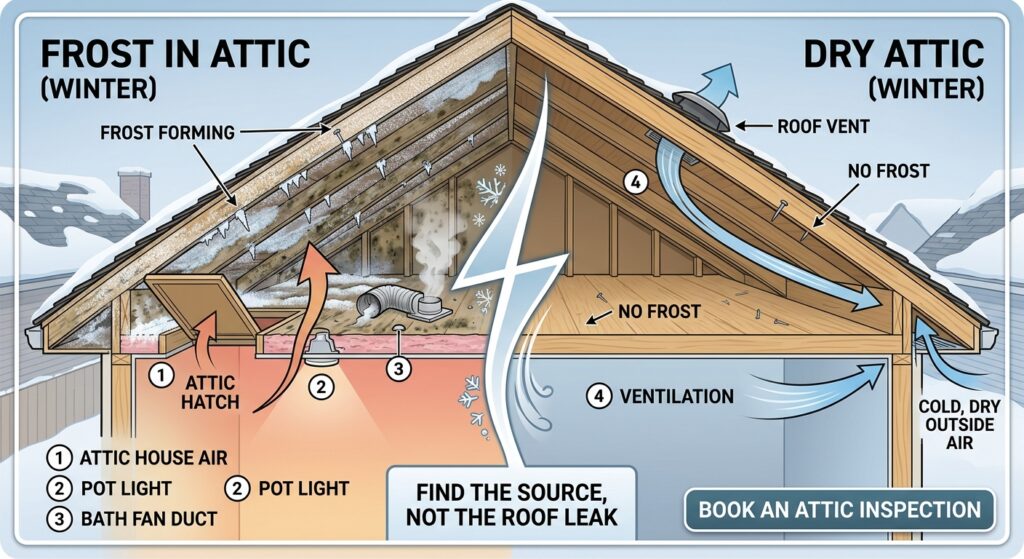
You push open the attic hatch on a cold January morning and the underside of the roof is white. Every nail poking through the roof deck has a little cap of frost on it.
Or you never look up there at all. Then in March, after the first mild week, a brown stain shows up on the bedroom ceiling.
Same problem. Different month.
The short answer: Frost in the attic is moisture from inside your house that got into the attic and froze on the coldest thing it could find: the underside of the roof deck and the nail tips. It’s almost never a roof problem. It’s usually a bathroom fan that ends in the attic, warm air leaking up through the ceiling, or too much humidity in the house. Fix the source, not the roof.
Here’s why that matters. The stain in March looks exactly like a roof leak. So people call a roofer, and a roofer quotes a roof.
What Attic Frost Actually Is
Think of a cold can of pop on a hot summer day. Water beads up on the outside of the can. It didn’t leak out of the can. It came out of the air.
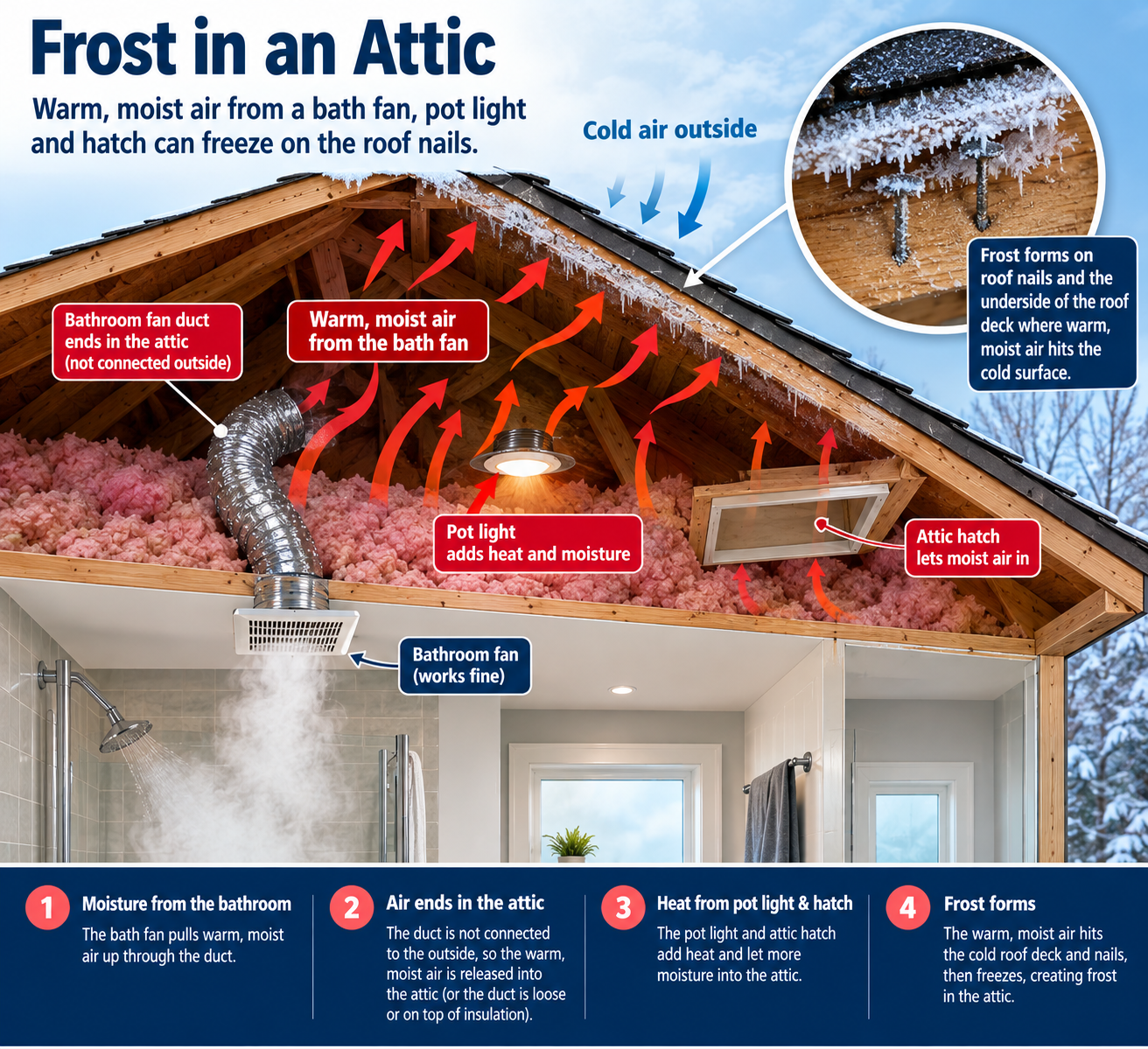
In January, your roof deck is the can. The warm, damp air from your house is the summer day. When that air reaches the plywood under the shingles, the moisture in it condenses. Below freezing, it doesn’t bead up. It turns to frost.
Nails get it first. Steel carries cold through the roof faster than wood does, so the nail tips are the coldest points in the attic. That’s why frosty nails are usually the first thing people notice.
Frost builds up during long cold stretches, when it stays well below freezing for days. Then a mild day comes and it all melts at once.
Why It Looks Like a Roof Leak (But Usually Isn’t)
This is where most people get it wrong.
When the frost melts, the water drips onto the insulation, soaks through, and shows up as a stain on the ceiling below. Sometimes it drips out of a light fixture. It really does look like the roof failed.
A few clues usually point to frost, not a leak:
- Timing. The stain shows up after a thaw, not after a rainstorm. Summer storms do nothing.
- Pattern. Water shows up in lots of spots across the roof deck, not one spot under the chimney or a vent.
- Location. The worst of it sits over a bathroom, near the attic hatch, or above a row of pot lights.
- Rusty nail tips across the whole underside of the roof.
A house can have frost and a roof leak, of course. That’s exactly why someone needs to look from the inside before you spend money on the outside.
One more thing it’s not: an ice dam. Ice dams are ridges of ice on the outside edge of the roof, at the eaves, where heat escaping from the house melts the snow above it. Related cause, different problem, different place.
The Four Ways Warm, Wet Air Gets Into Your Attic
Your attic is supposed to be cold and dry, close to the temperature outside. When frost forms, something is pushing warm, wet house air into a space that was never meant to have it.
Here are the four usual suspects, in the order we’d check them.
1. A bathroom fan that ends in the attic
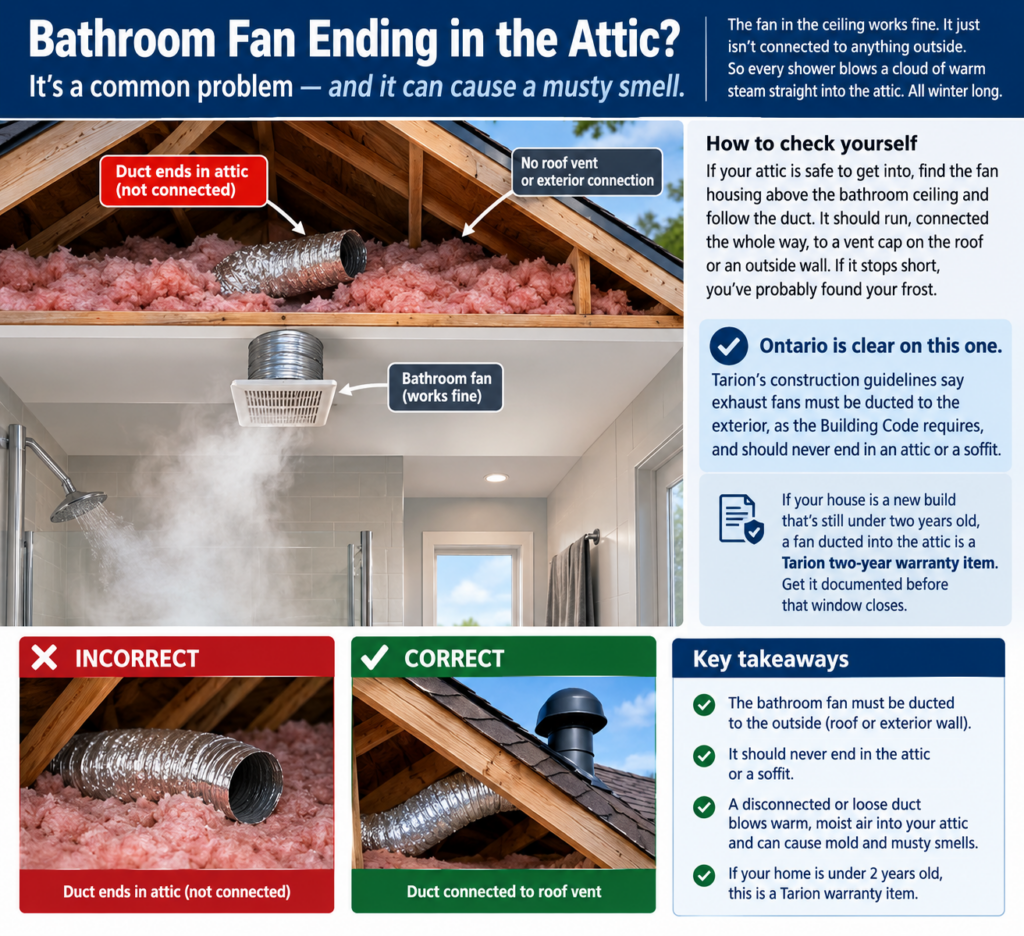
This is the one Balwinder finds most often when a homeowner calls about a musty smell. The fan in the ceiling works fine. It just isn’t connected to anything outside. The duct has come apart, or it’s lying on top of the insulation, or it was aimed at a roof vent and never attached.
So every shower blows a cloud of warm steam straight into the attic. All winter long.
You can check this yourself, if your attic is safe to get into. Find the fan housing above the bathroom ceiling and follow the duct. It should run, connected the whole way, to a vent cap on the roof or an outside wall. If it stops short, you’ve probably found your frost.
Ontario is clear on this one. Tarion’s construction guidelines say exhaust fans must be ducted to the exterior, as the Building Code requires, and should never end in an attic or a soffit. If your house is a new build that’s still under two years old, a fan ducted into the attic is a Tarion two-year warranty item. Get it documented before that window closes.
2. Air leaking up through the ceiling
Warm air rises. In winter, your house acts a bit like a hot-air balloon, pushing warm air up and out through any hole in the top.
The holes are usually small and boring:
- Pot lights that aren’t airtight
- An attic hatch with no weatherstripping
- Plumbing vent pipes and wiring holes that were never sealed
- The tops of interior walls
Each one is tiny. Together, they can move a lot of moist air into the attic.
3. Too much humidity in the house
If your windows are dripping on the inside in winter, your attic probably isn’t happy either.
Canada’s national housing agency, CMHC, says indoor humidity shouldn’t go above 50% during the heating season, and that in very cold weather you may need 30% or lower to stop condensation on windows. A cheap hygrometer from the hardware store tells you where you stand.
The usual culprits: a furnace humidifier set too high, laundry drying indoors, lots of cooking with the range hood off.
Brand-new houses are a special case. The concrete and lumber keep drying out for the first winter or two, so a new build can be damper inside than a 40-year-old house.
4. Ventilation that can’t keep up
Soffit vents at the eaves let cold air in. Roof vents near the top let it out. That airflow carries some moisture away with it.
But when insulation gets pushed into the soffits and blocks them, the air stops moving. And even a well-vented attic can’t keep up with a bathroom fan blowing steam into it. Ventilation helps, but it doesn’t fix a moisture source. That’s why it’s last on this list.
What to Do If You See Frost Right Now
Don’t panic. And don’t scrape it. Scraped frost just lands on the insulation and melts there.
Here’s the order we’d go in:
- Check the bathroom fan ducts. Only if you can do it safely. Step on the joists, never between them, and wear a mask. If the hatch is in a closet and you’ve never been up there, let someone else go first.
- Turn the humidity down. Check it with a hygrometer, and turn the humidifier down or off during cold snaps.
- Run the fans. Bathroom fan on for every shower, and leave it running after you’re done. A timer switch makes this automatic. Range hood on when you cook.
- Weatherstrip the attic hatch. It’s one of the cheapest air leaks in the house to fix.
- Get ready for the thaw. Move anything stored in the attic off the insulation, and watch the ceilings underneath. If stains show up, write down where. That map tells an inspector a lot.
And two things not to do yet:
- Don’t pile on more insulation. It makes the attic colder and hides the leaks under a thicker blanket. Seal the air leaks first, then insulate.
- Don’t replace a roof because of a March stain until someone has looked at it from the inside.
When a Little Frost Is Normal, and When It Isn’t
A few frosty nail tips on the coldest morning of the year aren’t an emergency. If the frost fades without dripping and the wood underneath stays clean, keep an eye on it.
A white roof deck is a different story. Stop watching and get it looked at if you see:
- Frost or ice covering large parts of the roof sheathing
- Dark staining or black spots on the wood
- Insulation that’s wet, flattened, or clumped
- Ceiling stains that come back every spring
- A musty smell upstairs or when you open the hatch
That dark staining is the one to take seriously. Winter after winter of wet-then-dry is how attic mold gets started, and you can’t tell mold from water staining just by looking at it. That’s the point to test instead of guessing. Here’s what a mold inspection actually consists of. At Kirpa it’s $450 to $750 depending on how many areas are affected, and the air sampling and third-party lab analysis are included in that price.
How an Inspector Finds the Source
Frost is a symptom. The real job is finding where the moisture is coming from.
On an attic inspection in Brampton, we trace every exhaust duct to where it actually ends. We check how deep the insulation is and whether it’s blocking the soffits, look at the roof deck for staining, take moisture readings where the risk is highest, and check around the hatch, pot lights, and pipes for gaps.
Thermal imaging helps too, and winter is when it works best. An infrared camera pointed at the ceiling from inside shows cold streaks where warm air is escaping. A leaky pot light shows up as a bright ring on the screen. The bigger the temperature difference between inside and outside, the clearer the picture.
Buying a house this winter? The attic is the one place a winter inspection can show you more than a summer one, because the frost is right there to see. It’s one item on the full room-by-room list of what home inspectors look for, and it’s the room most buyers never climb up to see.
The Short Version
Frost in the attic is house moisture in the wrong place, not a bad roof.
Check the bathroom fan ducts first. Then the humidity. Then the air leaks through the ceiling. Ventilation last. Don’t scrape it, don’t add insulation yet, and don’t buy a roof until someone has looked from the inside.
Kirpa’s inspector, Balwinder, is InterNACHI certified and insured, and inspects attics across Brampton, Mississauga, Toronto, and the GTA.
Frequently Asked Questions
Is frost in the attic normal?
A light frost on a few nail tips during the coldest days is common, and usually harmless if it dries without dripping. Frost covering the roof deck isn’t normal. It means warm, moist air from the house is getting into the attic.
Will attic frost damage my roof?
Over several winters, yes. Repeated melting soaks the insulation so it insulates less, rusts the nails, stains the drywall, and can lead to mold and rot in the roof sheathing.
Will more insulation stop attic frost?
Not on its own. Insulation slows heat, not air. Seal the air leaks and fix any exhaust fan that ends in the attic first, then add insulation.
Can a bathroom fan vent into the attic?
No. In Ontario, exhaust fans have to be ducted to the outside. Tarion’s guidelines treat a fan that ends in the attic as a two-year warranty item on new homes.
Should I remove frost from my attic?
No. Scraping just drops it onto the insulation. Fix the moisture source, lower the indoor humidity, and keep an eye on the ceilings below when it thaws.
Frost on the Nails? Find the Source Before the Thaw
An attic inspection traces every exhaust duct, checks the insulation and ventilation, and pins down where the moisture is coming from, before the March stain shows up. InterNACHI certified and insured.
Serving Brampton, Mississauga, Toronto, and the GTA.
Book Your Attic Inspection →Or call (647) 474-5626