What’s the Difference Between a Basic and Thorough Home Inspector?
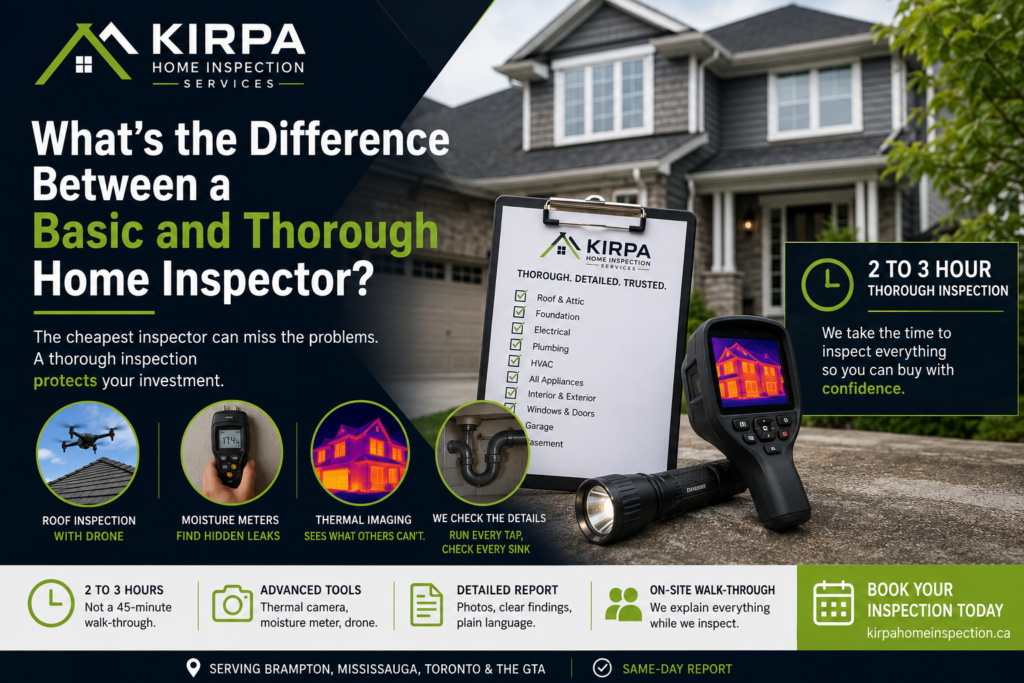
You’re about to hire someone to tell you if an $800,000 house is safe to buy. How do you know if you’re getting someone who will actually find the problems — or someone who’ll walk through in 45 minutes, hand you a generic checklist, and move on to their next job? That question matters more than most buyers realize. And almost nobody talks about the answer. The 45-Minute Inspection Is a Red Flag A thorough home inspection takes 2 to 3 hours. That’s not a suggestion — that’s what it takes to check every room, every wall, every system, every appliance, every corner of a house properly. If an inspector is done in 45 minutes or less, they didn’t inspect the house. They walked through it. At Kirpa, a standard inspection covers the roof, attic, foundation, electrical panel, plumbing, HVAC, all appliances, windows, doors, exterior, garage, and basement. You cannot do all of that in under an hour. Anyone who tells you otherwise is cutting corners — and you won’t know which ones until something breaks after closing. Rule of thumb: under 90 minutes for a detached home = walk away. The Small Details Are Where Bad Inspectors Disappear Here’s something most buyers don’t know: the difference between a basic and thorough inspector often comes down to the things that look minor. What Gets Checked Basic Inspector Thorough Inspector Window caulking Skipped Checked — failing caulk lets water in around the frame Downspout extensions Skipped Checked — too short pushes water toward the foundation Driveway cracks Skipped Checked — can indicate settling underneath Garage door auto-reverse sensor Skipped Tested — a safety hazard if it doesn’t function Every faucet and sink Glanced at Run and inspected underneath while water is flowing Roof Viewed from the ground only Inspected with drone where needed None of these are glamorous findings. But all of them matter — and all of them get missed when an inspector is rushing. What Happens When the Roof Gets Skipped Balwinder has inspected homes in Brampton where a previous inspector had already been through the property. One of the most common things he finds: the roof was never properly checked. In one case, a homeowner had been living with a leaking roof and water coming into the attic. The prior inspector had missed it entirely. By the time the damage showed up — staining on the ceiling, moisture in the insulation, compromised decking — the repair bill had grown well past what it would have cost to catch it early. A proper roof inspection isn’t optional. It’s one of the highest-value things an inspector does. If your inspector can’t get eyes on the roof — or skips it because it looks fine from the ground — you have an incomplete inspection. The Tools Separate the Professionals From the Checklist Guys A thorough home inspector shows up with more than a flashlight and a notepad. The right equipment lets them see problems that are physically invisible to the naked eye. A cheap inspector without these tools isn’t just less thorough — they’re physically unable to find certain problems. The issue exists. They just can’t see it. Balwinder has inspected homes after a low-cost inspector already submitted their report. In one case, there was water coming through the roof into the attic. The previous inspector missed it completely — no moisture meter, no thermal camera. The buyer had no idea until the problem got worse. That’s not a failure of effort. It’s a failure of equipment. Run Every Tap. Check Every Sink. One of the things Balwinder does on every inspection that many inspectors skip: he runs every faucet and tap in the house and looks underneath every sink while the water is running. It sounds basic. It takes extra time. And it catches leaks that would otherwise stay hidden until they damage the cabinet, the subfloor, or the ceiling below. The inspector who skips this step isn’t saving you time. They’re transferring the risk to you. What to Ask Before You Book When you’re comparing two inspectors — one at $299, one at $399 — don’t just look at the price. Ask these four questions: How long does your inspection take? If the answer is under 90 minutes for a detached home, walk away. What tools do you use? If they don’t mention a thermal camera and moisture meter, ask specifically. No tools = visual-only inspection, which misses an entire category of problems. Can I see a sample report? A good report has photos, specific findings, and plain-language explanations. A weak report is a generic checklist with checkmarks. Do you walk me through it on-site? A thorough inspector explains what they’re finding while they find it — not just in a PDF you read later at home. The cheapest inspector is rarely the best value. What you’re actually paying for is the time, the equipment, and the experience to find problems before they become your problem. What a Thorough Inspection Actually Does for You It’s not just about finding defects. A thorough home inspection: Several Kirpa clients have used their inspection report to negotiate thousands off the purchase price. Others have walked away from homes that looked good in photos but had serious structural or moisture issues underneath. That’s what you’re paying for. Not a checklist. An honest assessment from someone who looked at everything. Book a Thorough Inspection in Brampton Kirpa Home Inspection Services covers Brampton, Mississauga, Toronto, and the surrounding GTA. Every inspection is 2 to 3 hours. Thermal imaging and moisture meter included. Same-day report. Wondering what it costs? See the full Kirpa pricing breakdown →
How Much Does a Home Inspection Cost (2026 Pricing Guide)
Discover how much a home inspection costs in Brampton in 2026. Explore Kirpa Home Inspection’s transparent pricing, what’s included, factors that affect costs, and why a professional inspection can save you thousands in unexpected repairs.