
9 Signs a Basement Has Flooded Before (and How to Stop Mold From Moving In)
You’re standing in the basement of a house you’re about to spend eight hundred thousand dollars on.
It’s clean. It’s bright. Somebody painted recently — you can still smell it. The floor is new. There’s no water, no stain, no smell.
So it’s fine, right?
Maybe. Here’s the problem: a basement that flooded last spring and a basement that has never taken on a drop of water look almost identical after a weekend of work and $300 of paint. Water leaves a record, but the record is in places sellers don’t think to cover and buyers don’t think to look.
This is about where that record is. Nine things you can check yourself in about ten minutes, what each one actually means, and what to do about the moisture so mold never gets started.
One thing up front, because it should shape how you read the rest. Kirpa doesn’t do mold removal or waterproofing. We inspect and test, full stop — no remediation arm, no referral deal with a remediation company. So there’s no version of this where we make money by telling you a dry basement is wet.
Why Nobody Is Required to Tell You
In Ontario, sellers fill out a Seller Property Information Statement — and it’s voluntary. Plenty of listings don’t include one at all. Where one exists, it records what the seller says they know.
That’s not a conspiracy. It’s just a thin safety net. A seller who fixed a leak six years ago may honestly believe it’s a non-issue. A seller who bought the house already finished may not know the basement ever flooded.
Either way, the burden lands on you. So learn to read the room.
The 9 Signs
1 The tide line
Water that sits in a basement leaves a horizontal mark at the height it stopped. Not a puddle stain — a level line, running flat across a wall, a support post, or the side of the furnace.
Trust the line more than the wall. Concrete and drywall get painted. The steel post in the middle of the room usually doesn’t.
Crouch down. Look across the room at floor level rather than down at it — a flat line jumps out at eye level and disappears from above.
2 Rust at the base of everything metal
This is the sign that survives cover-ups, because nobody repaints appliance feet.
Check the bottom two inches of: the furnace cabinet and its legs, the water heater’s base ring, the washer and dryer feet, the support posts, the electrical panel’s bottom edge, any metal shelving legs.
Rust rings at a consistent height across several unrelated objects is water. One rusty thing is a spill. Five rusty things all rusted to the same height is a flood.
3 Efflorescence — the white chalky stuff
Look at the bare parts of the foundation wall for a white or greyish powder, sometimes crystalline, sometimes like a dusting of flour.
That’s efflorescence: mineral salts left behind when water moves through the concrete and evaporates on your side of it. It doesn’t mean the basement flooded from the outside in a storm. It means water has been passing through that wall.
You can brush it off with your hand. That’s actually the useful test — if it comes back later, the wall is still wet.
4 Paint that stops partway up the wall
Fresh paint on the bottom three or four feet of a foundation wall, older paint above it, is one of the most common tells there is.
Same with a single freshly painted wall in an otherwise untouched basement. Or a patch of new drywall mud with no matching reason for it.
Nobody paints the bottom half of a wall for fun.
5 Flooring that’s newer than the room
New laminate in a 1985 basement. Fresh vinyl plank in one room and old carpet everywhere else. A single replaced section in the corner nearest the floor drain.
Ask when it was done and why. The answer tells you a lot, including from how long it takes them to produce one.
6 Drywall that touches the floor
This one runs backwards from the others, so read it carefully.
When a basement is repaired properly after water, the drywall is cut and re-hung with a gap — usually half an inch to an inch above the slab — so the sheet isn’t wicking moisture up off the concrete.
So: drywall sitting flat on the floor tells you either no water repair was ever done, or it was done badly. Drywall with a deliberate gap at the bottom is evidence somebody knew what they were doing — and also evidence there was a reason to do it.
Pop off a section of baseboard if you can. The bottom edge of drywall is the most absorbent part of the sheet, and it’s where staining hides.
7 The sump pit tells on itself
If there’s a sump pit, take the lid off and shine a light in.
A water line or mineral ring inside the pit — it has run, and it’s run high.
Bone dry, dusty, cobwebs, pump not plugged in — either the basement genuinely stays dry, or the pump has been dead for a year. Those are very different futures.
No backup and no alarm — the pump is one power outage from being decorative. Storms cause the water and the outage at the same time.
Also find the discharge pipe outside and confirm it carries water away from the house rather than dumping it beside the foundation, where it goes straight back in.
8 Doors, trim and stairs that got wet
Solid wood in direct contact with the floor is honest. Check the bottom of door frames, the base of the stair stringers, and the bottom corners of any built-in cabinet.
You’re looking for swelling, splitting along the grain, dark staining, or paint that has bubbled and gone crusty near the floor.
9 The smell — and why “no smell” proves nothing
A musty basement is worth taking seriously. That smell is microbial, and it means something is damp somewhere.
But run this test properly. If the house has been aired out, if there’s an air freshener plugged in near the stairs, or if a dehumidifier has been running for three days before the showing, you will not smell anything.
Absence of smell is not evidence of a dry basement. It’s evidence of good staging.
If you do smell it and can’t find the source, that’s the strongest single reason on this list to bring somebody in — what a mold inspection consists of is mostly a description of finding exactly that.
Then Go Outside — The Cause Usually Is
Every sign above is a symptom. The cause is almost always within six feet of the exterior wall.
Take a walk around the house and check four things:
Which way does the ground slope? Soil should fall away from the foundation — roughly six inches of drop over the first ten feet. Flat is bad. Sloping toward the house is worse. Interlock and patios settle over time and quietly reverse the grade.
Where do the downspouts end? They should discharge at least six feet from the wall. A downspout emptying into a splash block right beside the foundation is delivering the entire roof to the exact spot you don’t want it.
Are the window wells clear? Leaves, soil built up above the window sill, no cover. A window well is a bucket sunk into the ground next to your basement window. Fill the bucket and it drains through the window.
Are the gutters actually working? Overflowing gutters mean the downspouts are irrelevant.
Here’s the part worth internalizing: three of those four are cheap. Extending a downspout costs $20. Regrading a corner is an afternoon. When someone tells you a basement needs $15,000 of interior waterproofing, ask what the grading and downspouts look like first.
Three Different Water Problems That Get Confused
Most articles on this topic mash these together, which is why people fix the wrong thing. They behave differently and they cost wildly different amounts.
| Problem | What it is | What you see |
|---|---|---|
| Bulk water | Actual liquid entering the basement — storm water, a failed sump, a sewer backup, a burst supply line | Dramatic and obvious. The one everybody pictures. |
| Capillary moisture | Water wicking slowly through concrete from the wet soil outside | No puddle, ever. This is the efflorescence one — a permanently slightly-damp wall and a basement that never quite feels right. |
| Condensation | Warm humid summer air hitting cool basement surfaces and giving up its water | No leak at all. Exactly like a cold glass sweating on a patio table. The water was already inside the house. |
Why this matters: condensation gets misdiagnosed as a leak constantly. Someone sees water beading on a cold water pipe or a damp patch on the floor near the wall in July and starts pricing out foundation excavation.
Quick test for it — tape a square of plastic sheet tightly to the foundation wall, all four edges sealed, and leave it a couple of days.
Moisture on the room side of the plastic is condensation, and you have a humidity problem.
Moisture trapped on the wall side is coming through the concrete, and you have a water problem.
Different diagnosis, different fix, different bill.
How to Actually Prevent Mold in a Basement
Mold needs three things: spores, something organic to eat, and moisture. Spores are already in every house on earth. Drywall paper, wood framing and cardboard boxes are the food. You cannot remove either.
Moisture is the only one you control. That’s the whole strategy.
Keep basement relative humidity below 60% — the line above which mold germinates on organic surfaces. Aim for 30–50%. A hygrometer costs about $20, and it’s the tool almost nobody buys.
Run a dehumidifier, and plumb it to the floor drain. A dehumidifier with a bucket gets emptied for two weeks and then stops getting emptied. Run a hose to the floor drain and it runs all summer without you.
Fans don’t dry anything. They move air. Air movement helps a dehumidifier work, but on its own a fan just relocates humidity to a cooler corner where it condenses instead. Airflow and water removal are two different jobs.
Get exhaust fans venting outside — actually outside. This is one of the most common real faults Balwinder finds on musty-smell calls: a bathroom exhaust fan that dumps into the attic instead of through the roof or wall. Every shower for years, straight into the insulation. Follow the duct and confirm it terminates at an exterior vent, not just that it disappears into a ceiling.
Be careful what you seal. Below-grade walls need to dry in some direction. A poly vapour barrier installed on the interior of a basement wall — extremely common in GTA basements finished in the 80s and 90s — can trap moisture between the plastic and the concrete, where nobody sees it until the drywall comes off. If you’re finishing a basement, this is worth getting right the first time and expensive to fix afterward.
Open the cabinet under every sink. A basement bathroom vanity, a laundry tub, a wet bar. A slow drip from a supply line or a drain trap doesn’t puddle on the floor where you’d see it — it soaks the particleboard cabinet base and stays there. Dark, enclosed, no airflow, and the cabinet base is usually MDF or particleboard, which is about the most absorbent material in the house. Run your hand along the back corners, not just the front.
Keep cardboard and fabric off the floor. Cardboard boxes on a concrete slab are mold food sitting on a moisture source. Shelves and plastic bins solve it for almost nothing.
Insulate sweating pipes. Foam sleeves, a few dollars, ten minutes. Stops a permanent drip you’d otherwise chase.
Fix leaks in days, not weekends. Mold can start on wet material within 24 to 48 hours. That clock is the single reason small water problems become large ones — not the volume of water, the delay.
Deal with the outside first. Grading, downspouts, window wells, gutters. You cannot dehumidify your way out of a downspout aimed at the foundation.
What an Inspector Finds That You Can’t
You can do everything above. Here’s the honest boundary of it.
Inside the wall cavity. Behind finished basement drywall is where this most often goes wrong, and it’s the one place a buyer walking through a house cannot look. Growth behind finished basement drywall is one of the two things Balwinder finds most often on musty-smell calls. No amount of careful looking gets you in there.
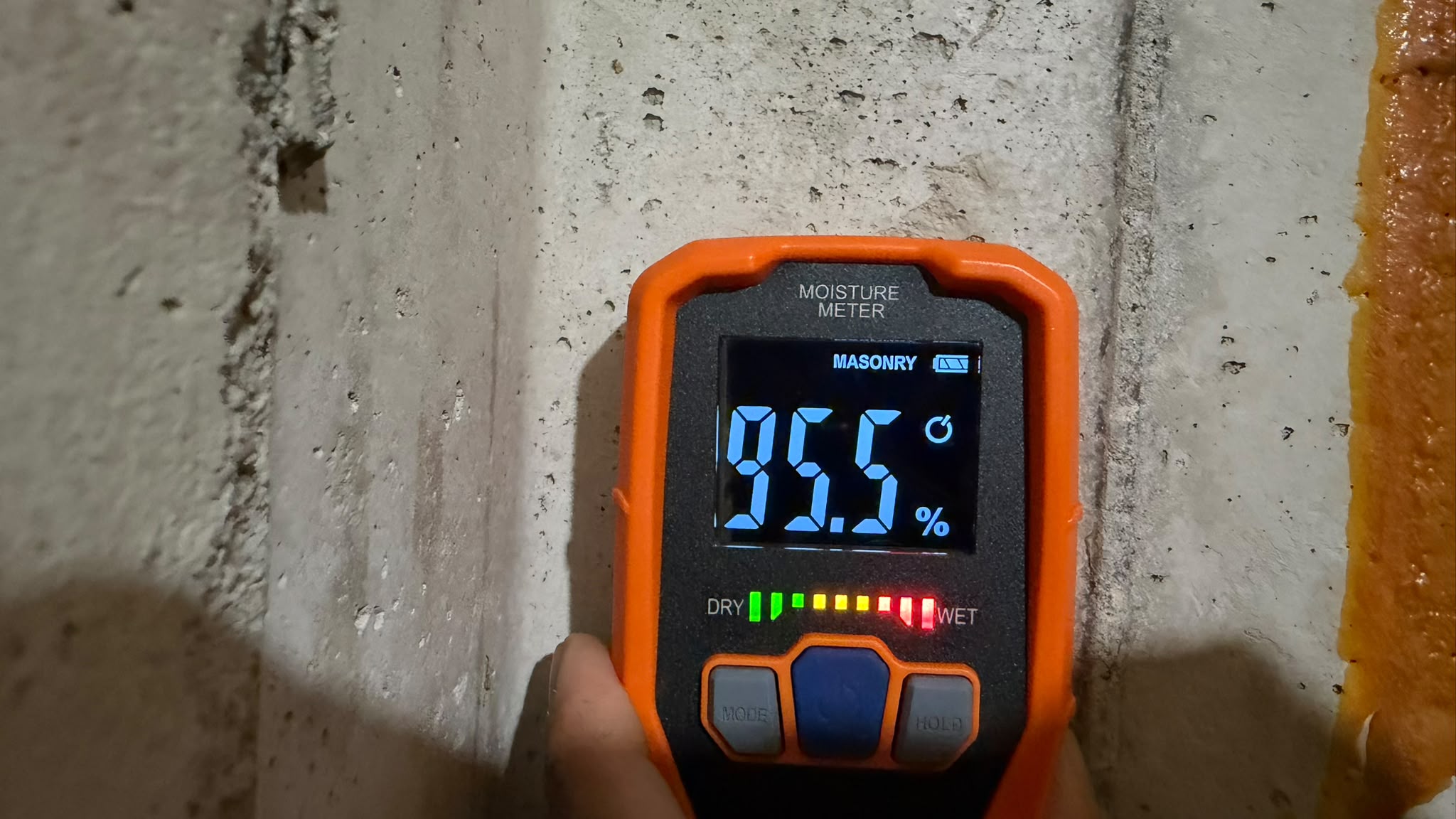
Moisture you can’t feel. A moisture meter reads material that is wet but not visibly wet. Your hand reads the outer millimetre of paint and nothing else.
Where to point the meter. Thermal imaging doesn’t measure moisture — it reads surface temperature, and evaporating water pulls heat out of material, so wet areas read cooler. That turns “check twenty spots and hope” into “check these three.” It’s also how you see the shape of a moisture pattern across a whole wall.
What’s actually in the air. Air sampling with third-party lab analysis is the only thing that answers is there mold here, as opposed to is this wall damp. At Kirpa the lab analysis is included in the price — it isn’t a fee added afterward.
A document somebody else will accept. A dated report with readings and photos is what an insurer, a lawyer, or a seller in a price negotiation will actually respond to. “I think the basement’s damp” is not a negotiating position. A report is.
A mold inspection and air quality test runs $450 to $750 depending on how many rooms are involved and takes one to two hours. It’s available on its own — you don’t have to book a full inspection to get one.
If it’s a home you’re buying, the more common route is the standard four-hour inspection with moisture and thermal work as part of it. Worth reading what separates the two approaches: a basic inspection versus a thorough one is largely a question of whether anyone opens the panel, checks the cavity, and gets on the roof.
And if you’ve already had water and you’re trying to work out whether the place has dried properly, that’s a different job with different tools — how to check moisture levels after a flood covers measuring it yourself day by day.
If You Find Evidence of a Past Flood — What Then?
Finding a flood history is not automatically a reason to walk away. Basements flood. Half the housing stock in the GTA has a story. What matters is what happened next.
Ask these, in this order:
- When, and how many times? Once in a hundred-year storm is a different animal than every spring.
- How high did it get? The tide line answers this whether or not anyone else does.
- What was the water? Clean supply-line water is a repair. Sewer backup through the floor drain is a contamination event, and porous materials it touched should have come out regardless of how dry they got.
- What was fixed — the symptom or the cause? New flooring is a symptom fix. A regraded lot, extended downspouts, a new sump with a battery backup, or a backwater valve is a cause fix.
- Is there paperwork? Permits, invoices, an insurance claim, a remediation report. Real work leaves paper.
- Was the wall cavity opened? If water reached the drywall and nobody opened it up, it was painted over wet. This is the question that most often changes the answer.
If they can’t answer 4, 5 and 6, you’re not being told the basement is fine. You’re being told nobody knows.
Common Questions
Can a seller legally hide that the basement flooded?
Ontario’s Seller Property Information Statement is voluntary, and disclosure obligations around defects a buyer couldn’t reasonably discover are a legal question, not an inspection one — talk to your real estate lawyer about your specific situation. Practically: assume nothing is disclosed and check for yourself.
Does efflorescence mean there’s mold?
No. Efflorescence is mineral salt, not organic growth — it’s chalky and dissolves in water, where mold is fuzzy and doesn’t. But it does confirm water is moving through that wall, which is the condition mold needs. Treat it as a moisture finding, not a mold finding.
A basement smells musty but there’s no visible mold. Is that normal?
It’s common, but it isn’t nothing. A musty smell with no visible source usually means growth in a spot you can’t see — inside a wall cavity, under flooring, or in the attic above. That combination is the clearest single reason to get air sampling done, because you can’t measure the size of a problem you can’t find.
What humidity should a basement be at?
Under 60% relative humidity, ideally 30–50%. A $20 hygrometer answers this in ten seconds and most people never buy one.
Will a standard home inspection catch a past flood?
A thorough one will catch the evidence — the tide lines, the rust, the efflorescence, moisture readings, and the exterior causes. What a standard inspection does not include is air sampling and lab analysis, which is what identifies actual mold. If there’s a smell, a known flood history, or someone in the household with asthma or allergies, add the mold inspection.
Do I need to test if I already found visible mold?
Often not. Toronto Public Health, working from CMHC guidance, treats patches under about one square metre as a homeowner clean-up job — detergent, gloves, mask, eye protection, and then fix whatever is wetting it. Testing earns its cost when you can’t find the source, when the area is large, when the water was contaminated, or when you need documentation for a sale or a claim.
Is a flooded basement a dealbreaker?
Usually not by itself. An unexplained one is. The difference between “it flooded in 2021, here’s the invoice for the regrading and the backwater valve” and “the previous owner mentioned something” is the entire negotiation.
The Short Version
Get low and look for a flat line. Check the bottom two inches of every metal thing in the room. Look for white powder on bare concrete, paint that stops halfway up a wall, and flooring newer than the room it’s in. Take the sump lid off. Then go outside and look at where the water lands.
Do that and you’ll know more about the basement in ten minutes than most buyers learn before closing.
The rest — inside the wall, inside the air — is what the meter and the lab are for.
Not Sure What That Basement Is Hiding?
Kirpa Home Inspection Services — InterNACHI certified, licensed and insured. Home inspections, mold and air quality testing, and thermal imaging across Brampton, Mississauga, Toronto and the GTA. Air sampling and lab analysis included. No remediation upsell, because we don’t do remediation.
Book an Inspection →